I guess there is a DVD market for sequels to popular films that really need no sequel. Films produced purely for the market. Films that are simply tied to the labor that produces them and representing nothing else. When you're in a corner store and there are shelves of items placed beneath and around the cash register: products for you to purchase, relatively cheap, that you are meant to consume or throw away. These straight to DVD sequel-films are like that 5th Avenue bar that catches your eye. You know what it tastes like. You're not really interested in it. But you pick it up and eat in while walking to the bus and throw the wrapper in the trash next to your stop and then you forget about it.
For example, we have War Games 2: The Dead Code.
Candy. Fluff. Made to make you fat, happy, dumb, and numb.
Now, you want to sell poetry and prose in a market that is almost impossible to break into in an intellectual, scholarly, artistic, dedicated, thoughtful, and meaningful manner. You could write contract novels, you could ghost write, you could become a consultant and write technical manuals. You could do all this and write you're earnest text on the sly, out of the market, on the side, so to speak.
But let's say all you really want to do is make some bread. Well. Make a sequel. And find somebody to place it on a shelf where people can see it as they browse for their mass market fare. Sure, some serious text can be gleaned in the mass shelves of shit that sell thousands. But you want that shopper as well as the mainstream shopper who reads simply to pass the time. You want everybody to buy your book. Make it a sequel.
Maybe you could create a market for poetry. Finally. After all these years. You have been a student of Whitman. And Ginsberg. And now your poetry, your lines, have the flavor of the great wanderer but you are firmly planted in the contemporary. And people simply won't take the time to read what you have seen and observed and pointed to and nobody is engaged by what has been revealed to you, nobody knows what you behold.
Well, sequel-ize it. Leaves of Grass 2: Sidewalks and Cul-de-Sacs Or Howl 2: Gotta Walk Against the Flow of Traffic.
Or, maybe you're like me and trying to learn how to write a great American novel that is both thoughtful and provacative. Maybe you want people to read your terse prose verse. Your working with Williams, Creeley, Olson, Stein, and Pound: your working these poets and critics into your prose and attempt to bring poetics into play as a philosophy of fiction. But maybe nobody cares.
Well, that's ok. You can write that great book. Put all your effort into it. And simply make it a sequel. You'll call it Moby Dick 2: The Ishmael Papers or Huckleberry Finn 2: The Meth Years.
Oh you'd sell some books.

Friday, April 11, 2008

Tuesday, April 1, 2008
In the Bedroom

One of my favorite films of this decade. Todd Field's direction is superb; he seems to have really cared about the story and its ability to develop an idea. I enjoy a film (and its production) that permits unfolding occurrences authenticity.
The set-up, the construct is really quite simple: Son/Young Man has fling with Older, Married Woman whose unstable and scorned Lover/Husband purposefully confronts and assaults but recklessly murders the Son; Resolute Father confronts Lover and avenges his Son's murder.
What a viewer gets with In the Bedroom is the tale. And that encourages the viewer to think about what and how events occur. Field's direction (and Frank Reynolds's editing, for that matter,) creates a space for speculation and reflection as the story progresses. Many films are directed and edited in an insistent and persistent manner. Many narratives call for such insistence. You want a viewer (or reader) to see this event in this manner, and so on. I like the odd films that ask me to become engaged enough to do some work.
When I hear "In the Bedroom", I think about all those private things we all decide are best left in the bedroom. And the title does relate all the events to the sex act. So, we are observing something authentically primal, possibly something repressed.
Watching Frank Fowler's parents struggle to come to terms with his murder is poignant and mysterious. How does his father arrive at the decision to act as he does? How does his mother permit such action? Is she powerless to act? Or, is her silence something much more significant?
A murder is an over-abundant act with the excess often purposefully edited out of any archive, any record, and sometimes memory. The suffering is often not precise, accurate, nor efficient enough to film. It is much simpler to tell the story about what happens after all the major characters in a narrative respond to a traumatic event. In the Bedroom dispenses with the afterwards and dwells in the possibilities in the wake of the trauma. We get, after very little setting, a horrific act and a study of the time before the next horrific act that, in many ways, is in response to the first act. But the question is left, I think, about inevitability.
Upon subsequent screenings, I am shocked that the film doesn't insist on an inevitable outcome. It is inevitable, I suppose, in that the father's retaliation is written and filmed. But the tone and pacing, as well as the acting, all lead me to continue to consider possibility--the possibility that he will not retaliate or that he was always waiting for the moment to retaliate. There is a bit of determinism or, more appropriate, naturalism in this story. Antonio Calvache's photography captures this quite well. There is so much in excess after Frank Fowler's death.
The title of the film insists that the characters are in some manner responsible for everything that occurs. The quiet town. I don't know how to put it exactly, but there is some critique of the pastoral in this film. In the sense that this family has purchased some stake in the romanticized and idealized version of small town life in the United States that is inauthentic and possibly wholly bogus. I use pastoral because the concept contains a sense of spiritual guidance--not only the pasture and the sheep, but a tale about those who lead the sheep through the pasture.
If we examine the Christianity in Pastoralism, maybe we can see In the Bedroom as a story about what happens when the others we exclude and ignore--the scorned lover who seeks retribution, for example--insist on being a part of the scenery. Pastoralism does tend to ignore the outsiders. And William Mapother presents an strong outsider: he looks, thinks, and acts differently. He is an other. A stranger.
Thus the question becomes What are we willing to do to restore the order in our idealized lives? Not so much How far can we go? as much as How long can we endure?
Anyway, the film rewards repeated viewings.

Tuesday, August 28, 2007
Detective Story, 1951
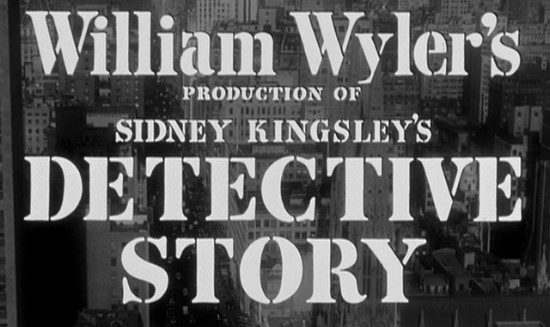
starring Kirk Douglas, Eleanor Parker, and William Bendix. Based on Sidney Kingsley's 1949 play and directed by William Wyler.
Detective Story deserves all the praise it gets. I especially appreciate Wyler's direction and the camera work. The film works much like the play must have: for example, there is an exaggeration involved with each performance that must have been necessary on stage but was not necessary for the performances in front of a camera. Rather than disrupt and disturb, the acting transforms simple, ordinary characters--detectives, witnesses, criminals, victims--into iconic representations of us all though we aren't all cops, dames, and bad guys.
I think that Wyler may have had Jules Dassin's The Naked City in mind. Whereas Dassin structured his film as a documentary that is interrupted by an engaging crime story--stories like this happen everyday in the city and I'm uncovering one with my camera--Wyler dispenses with the documentary frame and permits the dialogue and action to display its own immediacy and authenticity. Dassin's film is not inauthentic, but it does permit an imagined distance between characters and events in the film. Such a distance permits a less involved viewing experience. In other words, an audience may find more at stake while watching Detective Story than The Naked City. Detective Story has a here-and-now feel to it--a tone that theatre well-perceived is always good at portraying.
For 1951, the film seems significant. Detective Story is released in the midst of Film Noir's heyday, yet Wyler's film is not a film noir. Or better yet, it is a stripped-down film noir, stripped down to its language and character, stripped of its expressionistic style. We can use Wyler's film and its contrast to outstanding film noir to learn a lot about what was being said in these films and how that affects the way we tell similar stories now.
Thursday, June 14, 2007
The Big Combo (1955)

Joseph Lewis (1950's Gun Crazy) directs Phillip Yordan's script.
John Alton's photography is superb. Light and Dark combine to form an always present yet silent character who helps us understand the habits of each individual in the narrative.
The lighting and photography dictates much of the criticism of the film. The following is a typical description:
The movie opens with Susan Lowell (Jean Wallace) splashed in slanting shadows as she runs through tunnels beside a boxing ring. She's chased by two hitmen, Fante and Mingo (Lee Van Cleef and Earl Holliman), who have been hired by her Napoleonic lover, Mr. Brown (Richard Conte), to keep an eye on her. Cornered, she emerges from Alton's poetic darkness and agrees to stop running. By contrast, the hitmen remain in the dark, shapeless. Susan, centered in a spot-effect, looks stark, pale, and nearly naked.This contrast early in the film can distract a viewer with issues of female guilt, for example. Susan is naked throughout the film, awash in light. But the darkness takes the form of the closet in this film and, for the viewer who wishes to look beyond the naked woman, lurks an entire story about how men love each other and hurt each other and compete with each other to please each other. (Susan may often be filmed awash in light, but early in the film she is presented awash in light only shoulders and above. Her body is often obscured or completely blacked out.)
Aside from the odd ridiculous assessment of the film, The Big Combo is generally well received. For all the attention to the relationships between the men--the gangster and the cop, the gangster and his righthand man, the two hitmen, and a cop and his partner--I find it more than worthwhile to reflect on why it takes Turner Classic Movies interest in the film during Gay Pride Month to get more people talking about its explicit exploration of sexuality, masculinity, and violence.
I'd like to screen this in as a double feature with Miller's Crossing.
Tuesday, June 5, 2007
Not I
This is a 7 minute clip from Billie Whitelaw's performance in Samuel Beckett's Not I, from 1973. I love it; but I do really enjoy Julianne Moore in Neil Jordan's version as well. Jordan's is part of a collection of Beckett's work entitled, Beckett on Film, from 2000.
Subscribe to:
Posts (Atom)